Compartir
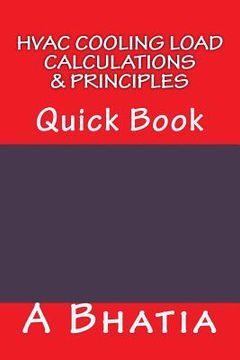
HVAC Cooling Load - Calculations & Principles: Quick Book (en Inglés)
A. Bhatia
(Autor)
·
Createspace
· Tapa Blanda
HVAC Cooling Load - Calculations & Principles: Quick Book (en Inglés) - Bhatia, A.
Libro Nuevo
Importado
Envío: 17 a 23 días háb.
$ 273.140$ 163.884
Costos de importación incluídos en el precio ✅
Reseña del libro "HVAC Cooling Load - Calculations & Principles: Quick Book (en Inglés)"
Heating and cooling load calculations are carried out to estimate the required capacity of heating and cooling systems, which can maintain the required conditions in the conditioned space. To estimate the required cooling or heating capacities, one has to have information regarding the design indoor and outdoor conditions, specifications of the building, specifications of the conditioned space (such as the occupancy, activity level, various appliances and equipment used etc.) and any special requirements of the particular application. For comfort applications, the required indoor conditions are fixed by the criterion of thermal comfort, while for industrial or commercial applications the required indoor conditions are fixed by the particular processes being performed or the products being stored. Generally, heating and cooling load calculations involve a systematic and stepwise procedure, which account for all the building energy flows. In practice, a variety of methods ranging from simple rules-of-thumb to complex transfer function methods are used to arrive at the building loads. This short quick book provides a procedure for preparing a manual calculation for cooling load using CLTD/CLF method suggested by ASHRAE and includes two detailed examples. For more advanced methods such as TFM, the reader should refer to ASHRAE and other handbooks. Learning Objective At the end of this course, the student should be able to: 1.Understand the basic terminology and definitions related to air conditioning load calculations 2.Explain the differences between heating and cooling load design considerations 3.Explain the difference between 1) space heat gain v/s cooling load 2) space cooling v/s cooling load and 3) external loads v/s internal loads 4.Differentiate between sensible and latent loads 5.List commonly used methods for estimating cooling loads 6.Estimate the internal and external cooling loads using CLTD/CLF method from building specifications, design indoor and outdoor conditions, occupancy etc. 7.Describe various equations and the information sources to determine conductive load through opaque building elements. 8.Describe various equations and information sources to determine the solar transmission load through glazing. 9.Describe various equations and information sources to determine the internal load due to people, lights and power appliances. 10.Determine the supply air flow rate 11.Learn by examples the detailed methodology to cooling load calculations 12.Learn the functional parameters of software programs such as TRACE 700 and CHVAC
- 0% (0)
- 0% (0)
- 0% (0)
- 0% (0)
- 0% (0)
Todos los libros de nuestro catálogo son Originales.
El libro está escrito en Inglés.
La encuadernación de esta edición es Tapa Blanda.
✓ Producto agregado correctamente al carro, Ir a Pagar.