Compartir
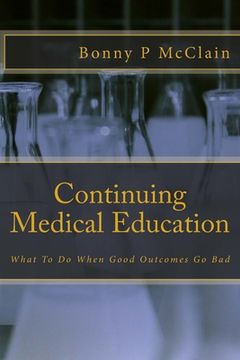
Continuing Medical Education: What To Do When Good Outcomes Go Bad (en Inglés)
Bonny P. McClain
(Autor)
·
Createspace
· Tapa Blanda
Continuing Medical Education: What To Do When Good Outcomes Go Bad (en Inglés) - McClain, Bonny P.
Libro Nuevo
Importado
Envío: 18 a 24 días háb.
$ 85.750$ 42.875
Costos de importación incluídos en el precio ✅
Reseña del libro "Continuing Medical Education: What To Do When Good Outcomes Go Bad (en Inglés)"
We currently measure how healthcare providers practice medicine and what clinical decisions are being made-how do we determine WHY? Determining effect sizes by merging outcome data from groups of study participants obscures the reality that clinical interventions rarely work for everyone and under all circumstances. In large part, clinicians are unable to face that reality because they lack information about the biological, experiential and environmental sources of that heterogeneity, and the impact of that heterogeneity on clinical responses. When an intervention known to be effective in study populations fails to work in a particular patient, clinicians therefore have little choice but to move to alternative interventions on the basis of pragmatic rules of thumb (heuristics). Assessing knowledge or even behavior by evaluating responses to an isolated clinical presentation forces participant responses into false "finite" siloes not dissimilar to inclusion/exclusion criteria in industry clinical trials-not actually real world or relevant in clinical practice. Since biological and social heterogeneity among trial participants interferes with the detection of true cause-effect relationships, controlled trials are carefully designed to minimize or eliminate heterogeneity's effects, primarily by aggregating the outcomes from many participants rather than drawing inferences from outcomes in individual persons. This intentional 'heterogeneity blindness' in controlled trials has brought with it a progressive shift from qualitative documentation of the concrete to quantitative assessment of the abstract-sophisticated statistical inferences about summary effect size in average patients. How do we create educational programs that are indeed measuring the appropriate outcomes? Do we want to limit our discussions to "educational" outcomes or is it possible to link learning objectives to meaningful patient-centric health outcomes?
- 0% (0)
- 0% (0)
- 0% (0)
- 0% (0)
- 0% (0)
Todos los libros de nuestro catálogo son Originales.
El libro está escrito en Inglés.
La encuadernación de esta edición es Tapa Blanda.
✓ Producto agregado correctamente al carro, Ir a Pagar.